
CHB vs. AAC Blocks: Which is Better for Your House Construction in the Philippines?
Choosing the right masonry material is one of the most important decisions in building your home. For decades, Concrete Hollow Blocks (CHB) have been the standard in Philippine construction. Today, Autoclaved Aerated Concrete (AAC) is emerging as a modern alternative.
If you're planning to build in Bacolod, Manila, or anywhere in the Philippines, understanding the difference between CHB and AAC will save you money, time, and future headaches. Let's break it down.
What Are CHB and AAC?
What is CHB (Concrete Hollow Blocks)?
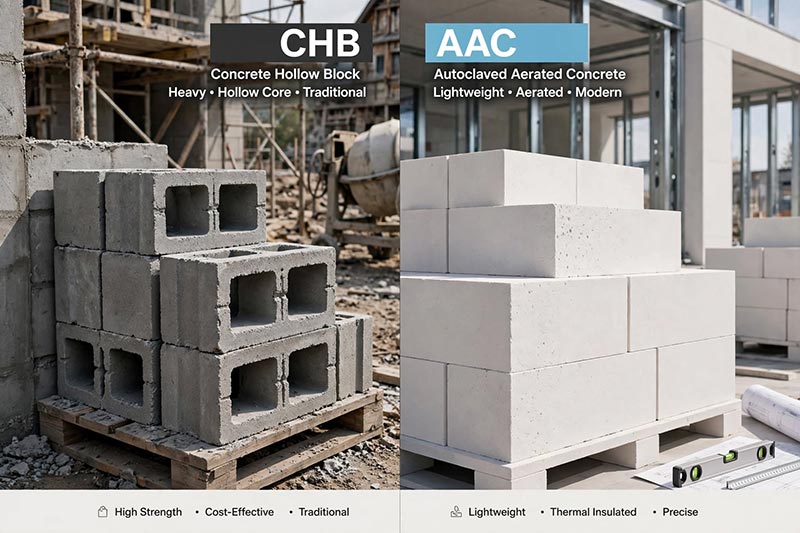
CHB, commonly called hollow blocks, is made from a mixture of cement, sand, gravel, and water. It is cured and has hollow cores in the middle. Standard sizes in the Philippines are 4", 6", and 8" thickness. It requires plastering on both sides and is reinforced with steel bars and concrete infill for structural integrity.
What is AAC (Autoclaved Aerated Concrete)?
AAC is a lightweight, precast, foam concrete material. It is made from cement, lime, sand, water, and an expansion agent (aluminum powder). It is cured in a high-pressure autoclave, creating millions of tiny air pockets. This makes it solid but extremely light - up to 3x lighter than CHB. It comes in precise blocks that can be cut like wood.
Head-to-Head Comparison: CHB vs AAC
|
Feature
|
CHB (Concrete Hollow Blocks)
|
AAC (Autoclaved Aerated Concrete)
|
|---|---|---|
|
Weight |
Heavy (12-18 kg per block)
|
Lightweight (6-9 kg per block)
|
|
Thermal Insulation |
Poor. Heats up easily, needs more AC
|
Excellent. 4x better insulation, cooler homes
|
|
Sound Insulation |
Low to moderate
|
High, due to air pockets
|
|
Construction Speed |
Slower, needs plastering & curing
|
30% faster, thin-bed adhesive, minimal plaster
|
|
Precision / Finish |
Uneven, requires thick plaster (10-15mm)
|
Very precise, 3mm thin plaster or skim coat only
|
|
Strength |
High compressive strength, good for load-bearing with reinforcement
|
Good compressive strength, but brittle - needs careful handling
|
|
Earthquake Resistance |
Heavy weight = higher seismic load
|
Lightweight = lower seismic load, better for earthquake zones
|
|
Cost (Material) |
Cheaper per piece (Php 18-35)
|
More expensive per piece (Php 90-150)
|
|
Cost (Total Project) |
Higher labor, plaster, steel, cement
|
Lower overall cost due to savings on labor, steel, plaster, and energy
|
Advantages and Disadvantages
1. Concrete Hollow Blocks (CHB)
Advantages of CHB:
- Proven and Widely Available: Every hardware in the Philippines sells CHB. Every mason knows how to use it.
- High Structural Strength: When properly reinforced with rebar and grout, CHB walls are extremely strong and ideal for load-bearing and perimeter walls.
- Lower Upfront Material Cost: The initial cost per block is significantly cheaper than AAC.
- Good for Wet Areas: Less water absorption than standard AAC if not waterproofed, making it familiar for toilets and kitchens.
Disadvantages of CHB:
- Poor Insulation: CHB absorbs and transfers heat. Homes become hot during the day and require more air conditioning, increasing electricity bills.
- Heavy and Slow: Its weight adds to the structural load and foundation requirements. Plastering is thick and time-consuming.
- Inconsistent Quality: Many local suppliers produce CHB with inconsistent mixing and curing, leading to cracks and weak blocks.
- More Wastage and Labor: Requires more cement, sand, steel, and manpower for plastering, mixing, and reinforcement.
2. Autoclaved Aerated Concrete (AAC)
Advantages of AAC:
- Superior Thermal Comfort: The air pockets act as natural insulation. Your house stays cooler by up to 4-6°C. Perfect for the Philippine climate and proven to cut AC costs by 25-30%.
- Lightweight & Fast Construction: 1 AAC block equals 3-4 CHB in size but is much lighter. This means faster laying, less steel for structural support, and lower foundation cost.
- Excellent Workability: Can be easily cut, drilled, and shaped for electrical and plumbing lines. No need for heavy chipping.
- Fire and Pest Resistant: AAC is non-combustible with up to 4-hour fire rating. It is also resistant to termites and pests.
- Smoother Finish: Its precise dimensions mean you only need a 3mm skim coat instead of thick plaster, saving on materials and giving a premium flat finish.
Disadvantages of AAC:
- Higher Initial Cost: The block itself is 3x to 5x more expensive than CHB, which can scare first-time builders.
- Requires Skilled Installers: Needs thin-bed adhesive and special tools. Not all traditional masons are trained for it. Improper installation causes cracks.
- Brittle Nature: Can chip or break if not handled properly during transport and installation.
- Availability Issues: While growing in Luzon and Cebu, supply in some provinces like Western Visayas can be limited compared to CHB. You need to order from authorized dealers.
- Needs Waterproofing: AAC is porous. Exterior walls need proper waterproofing paint and interior wet areas (CR, kitchen) need water-proofing treatment.
So, Which Should You Use for Your Home?
Choose CHB if: You have a tight upfront budget, your site is in a very remote area with no AAC dealer, and you have a traditional contractor who is an expert in CHB reinforced construction.
Choose AAC if: You want a cooler, energy-efficient, and faster-to-build modern home. It is ideal for second floors, residential houses, apartments, and any project where you want to save on long-term electricity and structural costs. Despite the higher price per block, most homeowners recover the cost within 2-3 years through labor and energy savings.
Pro Tip from Builders: Many architects in the Philippines now use a hybrid approach - CHB for the ground floor and perimeter fence (for strength and moisture resistance) and AAC for the second floor and interior partition walls (for lightweight and insulation).
Final Verdict
Both materials can build a strong home when used correctly. CHB is the traditional workhorse - cheap and strong. AAC is the modern smart choice - lightweight, insulating, and future-proof.
If your priority is long-term comfort, lower energy bills, and faster construction, AAC is the better investment for your dream home in the Philippines.
FAQ CHB vs AAC
Q1: Is AAC stronger than CHB?
CHB has higher compressive strength when reinforced with steel and grout, making it better for heavy load-bearing. AAC is strong enough for up to 3-storey residential buildings but is designed to be lightweight.
Q2: Is AAC cheaper than CHB in the Philippines?
Per piece, AAC is more expensive. Per project, AAC is often cheaper overall because you save on steel, cement, plaster, labor, and future electricity.
Q3: Does AAC need plastering?
No thick plastering needed. AAC only needs a 3mm thin skim coat, unlike CHB which needs 10-15mm plaster on both sides.
OUR PROJECTS
Get Your Custom Quote
Answer a few questions about your project and we'll provide you with a detailed quote.
What type of project are you planning?
New Home Construction
Build a custom home from the ground up
Home Renovation
Remodel or renovate existing space
Home Addition
Add rooms or expand existing space
Commercial Project
Office, retail, or industrial construction
What size project are you planning?
Timeline and Budget
Project Location & Preferences
Contact Information
Submitting your quote request...
Quote Request Submitted Successfully!
Thank you for your interest! We'll review your request and will get back to you as soon as possible. Also, a copy of the inquiry was sent to your email.
AB Architectural Designs Co. Bacolod City
Contact Numbers:
+63 34 4337933
Arch. Rolem L. Basiya
09985800955
Arch. Roberto T. Aguillon
09176257225
Email:
abarchidesigns@gmail.com
info@ab-archidesigns.com
AB Architectural Designs Co. Iloilo City
Blk 38 Lot 18& 20
Ana Ros Village, Mandurriao
Iloilo City
Contact Numbers:
+63 9985800955 / +639176257225
Email:
abarchidesigns@gmail.com
info@ab-archidesigns.com