
Light Gauge Steel vs. Concrete Block House: Which Is Better For You?
What Are We Actually Comparing?
1. Light Gauge Steel Framing (LGSF)
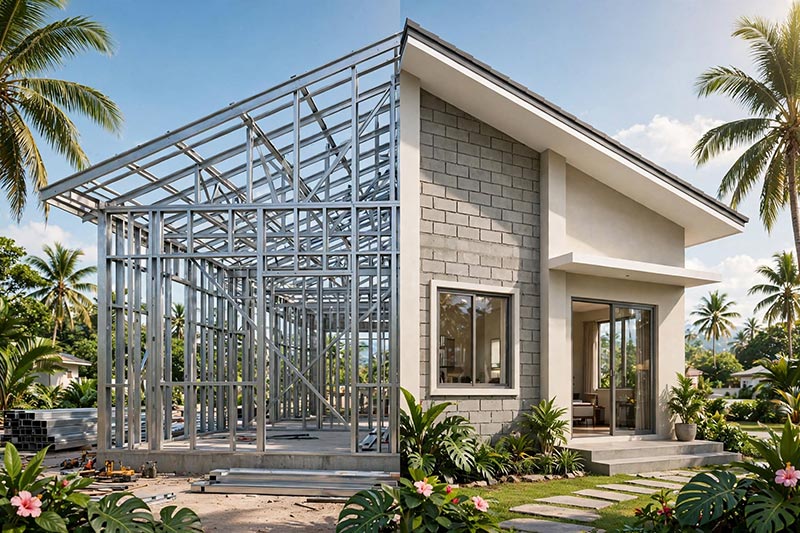
Think of it like building with a giant, super-strong metal Lego set.
Thin steel pieces are cut exactly to size in a factory, delivered to your lot, then screwed together to form your walls and roof frame. After that, boards are placed on the inside and outside, insulation is added in the middle, and then you paint and finish it like a normal house.
From the outside, it can look exactly like any other house.
2. Concrete Masonry / CHB House
This is the house most Filipinos grew up in.
Builders make concrete posts and beams, then fill the walls with Concrete Hollow Blocks (CHB) — those gray blocks you see in every hardware store. Then they plaster it, paint it, and finish it.
It is heavy, solid, and familiar to almost every mason in the country.
Cost: Which Is Cheaper?
There is no one price for the whole Philippines. Price changes by location, finish, and builder.
For a normal finished house in 2026, many builders quote:
- Budget house: around ₱20,000 to ₱25,000 per sqm
- Standard house: around ₱28,000 to ₱32,000 per sqm
- ** nicer finish:** ₱38,000 to ₱45,000 per sqm
Steel house: The steel parts can cost more at first. But you may save on foundation, labor time, and waste because it is lighter and faster to put up.
Concrete house: The blocks themselves are cheap. But you pay more for labor time, formwork, plastering, and waiting for concrete to dry.
Simple rule: Don't compare a steel shell to a concrete finished house. Ask both builders for a price for the same finished house — painted, tiled, with lights, outlets, and plumbing. That is the only fair comparison.
Speed: Which Builds Faster?
Steel wins here, clearly.
Because the parts are made in a factory, workers just assemble them on site. No waiting for concrete to dry.
Concrete takes longer because you have to pour, wait, remove formwork, lay blocks one by one, then plaster and wait again.
If you are in a hurry — for example, you need to move in before school starts, or you want to rent it out sooner — steel is usually the faster choice.
If you are not in a hurry, speed may not matter as much.
Earthquake: Which Is Safer?
Both can be safe. Both can be dangerous if built badly.
Steel houses are lighter. Lighter houses shake less in an earthquake, so there is less force on the house.
Concrete houses are heavier. But if they have the right steel bars inside, the right concrete mix, and the blocks are filled properly, they are also very strong.
The real danger is not the material. It is a house built without a proper plan, without enough steel, or with poor workmanship.
Always ask for a signed plan from a licensed engineer. Do not build based on a sketch alone.
Typhoon: Which Holds Up Better?
Again, both can survive a strong typhoon if they are tied down properly.
What matters most is:
- Roof is firmly attached to the walls
- Walls are firmly attached to the foundation
- Windows and doors are strong and sealed well
- Cladding / roofing is screwed on properly, not just nailed
Steel houses make this tie-down system easier to check because you can see the screws and connectors.
Concrete houses feel more solid against wind and flying debris because the walls are heavy.
For coastal areas, both need extra care. Steel needs protection from rust. Concrete needs good waterproofing so water does not get in.
Living In It: Hot? Noisy? Comfortable?
Heat
Concrete stays cool in the morning but can hold heat at night.
Steel walls are thin, so without insulation they can get hot fast. With good insulation, a steel house can actually feel cooler.
Noise
Concrete blocks sound better. You hear less from the next room or outside.
Steel needs extra insulation inside the walls to feel as quiet.
Termites
Steel is not eaten by termites. Concrete blocks are not eaten either. But wood parts in both houses — like door frames and cabinets — still need protection.
Fire
Both need care in the kitchen. Steel does not burn, but it weakens in very high heat. Concrete handles heat longer. For steel houses, builders use special fire-rated boards for safety.
Maintenance: Which Is Easier To Take Care Of?
Steel house: Check the roof screws and joints every few years. If you live near the sea, check for rust more often.
Concrete house: Expect to repaint every 5 to 7 years. Watch for cracks in plaster and leaks in bathrooms and roofs. Water getting into CHB is the most common long-term problem.
Both houses last a long time if you keep water out, keep the roof in good shape, and fix small problems early.
Finding A Builder
This is often the deciding factor.
Concrete: You can find a mason almost anywhere in the Philippines. Almost every barangay has someone who knows how to lay CHB.
Steel: You need a trained crew. They are easier to find in Manila, Cebu, Davao, and other big cities. In a far province, it can be hard to find one.
If there is no good steel builder near your lot, concrete may be the smarter, safer choice — even if steel is faster on paper.
So, Which One Is Right For You?
Choose Steel If:
- You want to build fast
- Your lot has soft soil or is on a slope
- You are adding a second floor to an old house and don't want to make it too heavy
- You are building several identical houses, like townhouses or rentals
- You found a good, experienced steel builder near you
Choose Concrete Block If:
- Your lot is far from steel suppliers
- You have a tight budget and a trusted local mason
- You want a very customized design with lots of curves and special shapes
- You prefer the system everyone in your area knows how to fix
A Mix Of Both?
Many smart homeowners do both: concrete for the ground floor, steel for the second floor. You get a solid base and a lighter, faster top floor.
Frequently Asked Questions
Is a steel house strong enough for a typhoon in the Philippines?
Yes, if it is designed for your area and tied down properly from roof to foundation.
Is steel cheaper than concrete?
Sometimes yes, sometimes no. It depends on your lot, your builder, and your finish. Compare finished prices for the same plan.
Will a steel house rust?
It can, especially near the sea. Good coating, good screws, and keeping it dry will prevent most rust.
Can I hang a TV or heavy cabinets on steel walls?
Yes, but tell your builder before the walls are closed so they can add extra support inside the wall.
Is CHB still okay to use?
Yes. It is still the most common system in the Philippines and it works well when built correctly.
OUR PROJECTS
Get Your Custom Quote
Answer a few questions about your project and we'll provide you with a detailed quote.
What type of project are you planning?
New Home Construction
Build a custom home from the ground up
Home Renovation
Remodel or renovate existing space
Home Addition
Add rooms or expand existing space
Commercial Project
Office, retail, or industrial construction
What size project are you planning?
Timeline and Budget
Project Location & Preferences
Contact Information
Submitting your quote request...
Quote Request Submitted Successfully!
Thank you for your interest! We'll review your request and will get back to you as soon as possible. Also, a copy of the inquiry was sent to your email.
AB Architectural Designs Co. Bacolod City
Contact Numbers:
+63 34 4337933
Arch. Rolem L. Basiya
09985800955
Arch. Roberto T. Aguillon
09176257225
Email:
abarchidesigns@gmail.com
info@ab-archidesigns.com
AB Architectural Designs Co. Iloilo City
Blk 38 Lot 18& 20
Ana Ros Village, Mandurriao
Iloilo City
Contact Numbers:
+63 9985800955 / +639176257225
Email:
abarchidesigns@gmail.com
info@ab-archidesigns.com