
Beyond Concrete: Why Architects Are Now Designing Communities — Not Just Buildings
In the Philippines, the strongest structures are not made of concrete.
They are made of people.
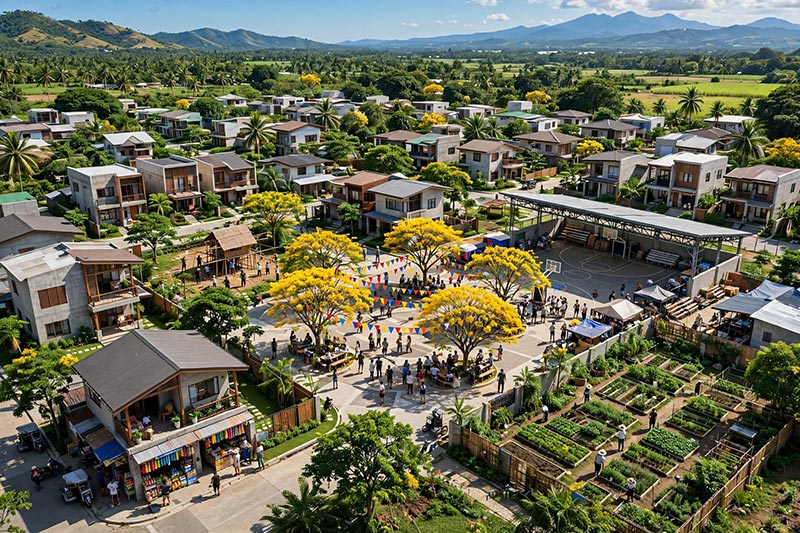
This is why the best Filipino architects and home builders in 2026 have moved beyond concrete. We are no longer just designing houses, condos, and commercial buildings. We are designing communities — the spaces, systems, and social infrastructure that allow bayanihan to thrive.
A beautiful subdivision in Bacolod with high walls, no sidewalks, and no shared space is a failed community — even if every house looks expensive. A modest barangay with a shaded plaza, a basketball court that doubles as an evacuation center, and a market where neighbors meet daily is a successful one.
What Does "Designing Communities" Mean?
Traditional architecture asks: What building are we building?
Community architecture asks: What relationships will this building create?
It has three layers:
1. Physical Community: Streets, plazas, parks, and shared spaces that bring people together instead of separating them.
2. Social Community: Design that supports Filipino social rituals — fiestas, sari-sari store kwentuhan, Sunday basketball, and family gatherings.
3. Resilient Community: Design that helps a community survive typhoons, floods, and earthquakes together, not alone.
This is social infrastructure — and in the Philippines, where we live through Yolanda, Odette, and every habagat, it is more important than any concrete wall.
3 Examples of Community Design in the Philippines
1. From Subdivision Walls to Shared Streets
The old Filipino subdivision model: 2-meter high walls, gated entrance, cars only.
The community design model: We design streets as living rooms.
We design:
- Walkable, shaded streets with narra trees and covered walkways so kids can walk to school safely and lolas can do morning walks without heat stroke
- Pocket parks every 200m — not one giant park far away, but small, usable spaces where neighbors actually meet
- Low fences and front porches instead of high walls, so you see your neighbors and feel safe because of eyes on the street, not cameras
In Bacolod, we are seeing this shift in new developments in Talisay and Silay — from isolated lots to clustered homes around a shared green.
2. The Barangay Hall, Covered Court, and Plaza as One Ecosystem
In every Filipino town, the center of life is not a mall. It is the triangle: Barangay Hall + Covered Court + Plaza.
A community-design architect treats this triangle as one system:
- The Covered Court is not just for basketball. We design it with solar panels, rainwater tanks, and a raised floor so it becomes a typhoon evacuation center within 2 hours.
- The Plaza is not just decoration. We design it with movable stalls for the night market, a stage for fiestas, and shaded seating for seniors.
- The Barangay Hall is not just an office. We design it with a community kitchen and a health station so during disasters, it can feed 500 people.
When we design these three together, we are designing resilience.
3. The Sari-Sari Store, The Chapel, and The Community Kitchen
The smallest Filipino community anchors are also the most powerful.
We now intentionally design for them:
- Sari-sari store corners at intersections, not hidden inside, so they become natural meeting points
- Community gardens on vacant lots where families grow malunggay, okra, and calamansi together — reducing food costs and building relationships
- Shared spaces in socialized housing — In Gawad Kalinga and Habitat projects, we learned that a shared laundry area and a communal garden create more community than 100 identical concrete houses
This is beyond concrete. This is designing bayanihan into the blueprint.
Why You Should Hire a Community-Focused Architect in the Philippines
Whether you are a developer building a subdivision in Bacolod, a barangay captain planning a covered court, or a family building your dream home, ask these questions:
- How does this design encourage neighbors to meet, not just pass by?
- Where will 100 people gather safely during a typhoon?
- Where do kids play without crossing a highway?
- Where do seniors sit in the shade and watch the world?
- What shared space will make this place feel like atin, not just akin?
A builder who can only answer with floor area and finishes is building concrete. An architect who can answer with community, resilience, and bayanihan is designing a place people will love for generations.
In the end, concrete cracks. Paint fades. Roofs leak.
But a community designed well — where people know each other's names, where kids are safe, where help arrives before the government does because your neighbor is already there — that lasts.
That is why we go beyond concrete.
FAQ's
What is community design in Philippine architecture?
Community design in Philippine architecture is designing shared spaces like plazas, covered courts, walkable streets, and community gardens that encourage bayanihan, social interaction, and disaster resilience, not just individual buildings.
Why is designing communities important in the Philippines?
Designing communities is important in the Philippines because strong social infrastructure helps barangays survive typhoons and floods, reduces crime through neighbor interaction, and preserves Filipino culture of bayanihan and family gatherings.
OUR PROJECTS
Get Your Custom Quote
Answer a few questions about your project and we'll provide you with a detailed quote.
What type of project are you planning?
New Home Construction
Build a custom home from the ground up
Home Renovation
Remodel or renovate existing space
Home Addition
Add rooms or expand existing space
Commercial Project
Office, retail, or industrial construction
What size project are you planning?
Timeline and Budget
Project Location & Preferences
Contact Information
Submitting your quote request...
Quote Request Submitted Successfully!
Thank you for your interest! We'll review your request and will get back to you as soon as possible. Also, a copy of the inquiry was sent to your email.
AB Architectural Designs Co. Bacolod City
Contact Numbers:
+63 34 4337933
Arch. Rolem L. Basiya
09985800955
Arch. Roberto T. Aguillon
09176257225
Email:
abarchidesigns@gmail.com
info@ab-archidesigns.com
AB Architectural Designs Co. Iloilo City
Blk 38 Lot 18& 20
Ana Ros Village, Mandurriao
Iloilo City
Contact Numbers:
+63 9985800955 / +639176257225
Email:
abarchidesigns@gmail.com
info@ab-archidesigns.com